Do you need planning permission for a heat pump? UK 2026 guide
Last reviewed: 14 May 2026
Most domestic heat pump installations don't need a full planning application — they fall under Permitted Development rights. This guide explains exactly when PD applies, what changed in the 2023 and 2025 rule updates, and the five situations where you do need to apply.
Last reviewed: 14 May 2026
In short
For the vast majority of UK homeowners, an air source heat pump can be installed without applying for planning permission. The legal basis is Class G of Part 14 of Schedule 2 of the General Permitted Development Order 2015 — a Permitted Development (PD) right that covers most domestic ASHP installs, provided four conditions are satisfied: the outdoor unit is no larger than 1.5 m³, only one unit is installed (two for detached homes), it isn’t placed on a pitched roof or within 1 m of a flat-roof edge, and an MCS 020(a) noise assessment shows the unit will produce no more than 37 dB at the nearest neighbour’s habitable room window.
PD does not apply in five situations: conservation-area installs on a wall facing the highway, listed buildings, flats and maisonettes, areas covered by an Article 4 direction, and other designated areas (National Parks, World Heritage Sites). In those cases, a full planning application to the local council is required — for Reading-area properties, that’s Reading Borough Council, West Berkshire Council, or Wokingham Borough Council depending on address.
The two rule changes that matter for 2026 decisions: the 1-metre boundary rule was abolished in December 2023, and the noise limit was tightened from 42 dB to 37 dB from September 2025. Together these mean previously-blocked terraced and dense semi-detached installs are now viable, but unit choice and siting need to satisfy the lower noise threshold.
Table of contents
- The legal basis — Class G of the GPDO 2015
- The four conditions you must satisfy under PD
- What changed in 2023 — the boundary rule and unit size
- What changed in 2025 — the MCS 020(a) noise update
- Five situations where PD does not apply
- The full planning application route — process and timeline
- What your installer should produce as PD evidence
- If the noise calculation doesn’t pass — four options
- What this means for homes in Reading
- Three questions to ask before committing to an install
The legal basis — Class G of the GPDO 2015
The right to install a heat pump without applying for planning permission isn’t an installer’s promise — it’s a statutory right granted by Class G of Part 14 of Schedule 2 to the Town and Country Planning (General Permitted Development) (England) Order 2015. That Order, often called the GPDO, sets out a long list of building works that homeowners can carry out without a planning application; Class G specifically covers air source heat pumps on domestic premises.
The GPDO has been amended in two substantive ways since it was first published. The first was in December 2023, when SI 2023/1279 widened Class G significantly — removing the 1-metre boundary rule, raising the outdoor-unit size limit from 0.6 m³ to 1.5 m³, allowing two units on detached homes, and broadening the scope to include reversible heating-and-cooling systems. The second was the MCS 020(a) noise standard update in 2025, mandatory from 20 September 2025, which lowered the maximum permitted sound level at the nearest neighbour’s window from 42 dB(A) under the old standard to 37 dB LAeq,5min under the new one.
The 2023 + 2025 combination is intentional. The 2023 changes removed siting obstacles that were keeping many terraced and densely-built homes out of the PD route entirely. The 2025 noise tightening offsets the proximity flexibility — your installer can now place the unit closer to a boundary, but the noise the neighbour receives still has to fall within stricter limits than the previous standard required.
The practical net is positive for most homes. Most heat pump installs that would have qualified under the old rules still qualify, and many that the old 1-metre boundary rule was disqualifying now fit comfortably within the new framework — provided the design takes the noise threshold seriously.
The four conditions you must satisfy under PD
For an install to fall under Class G PD, four cumulative conditions must all be satisfied. If any one of them fails, you need a full planning application (or you need to change the design).
1. Outdoor unit no larger than 1.5 m³
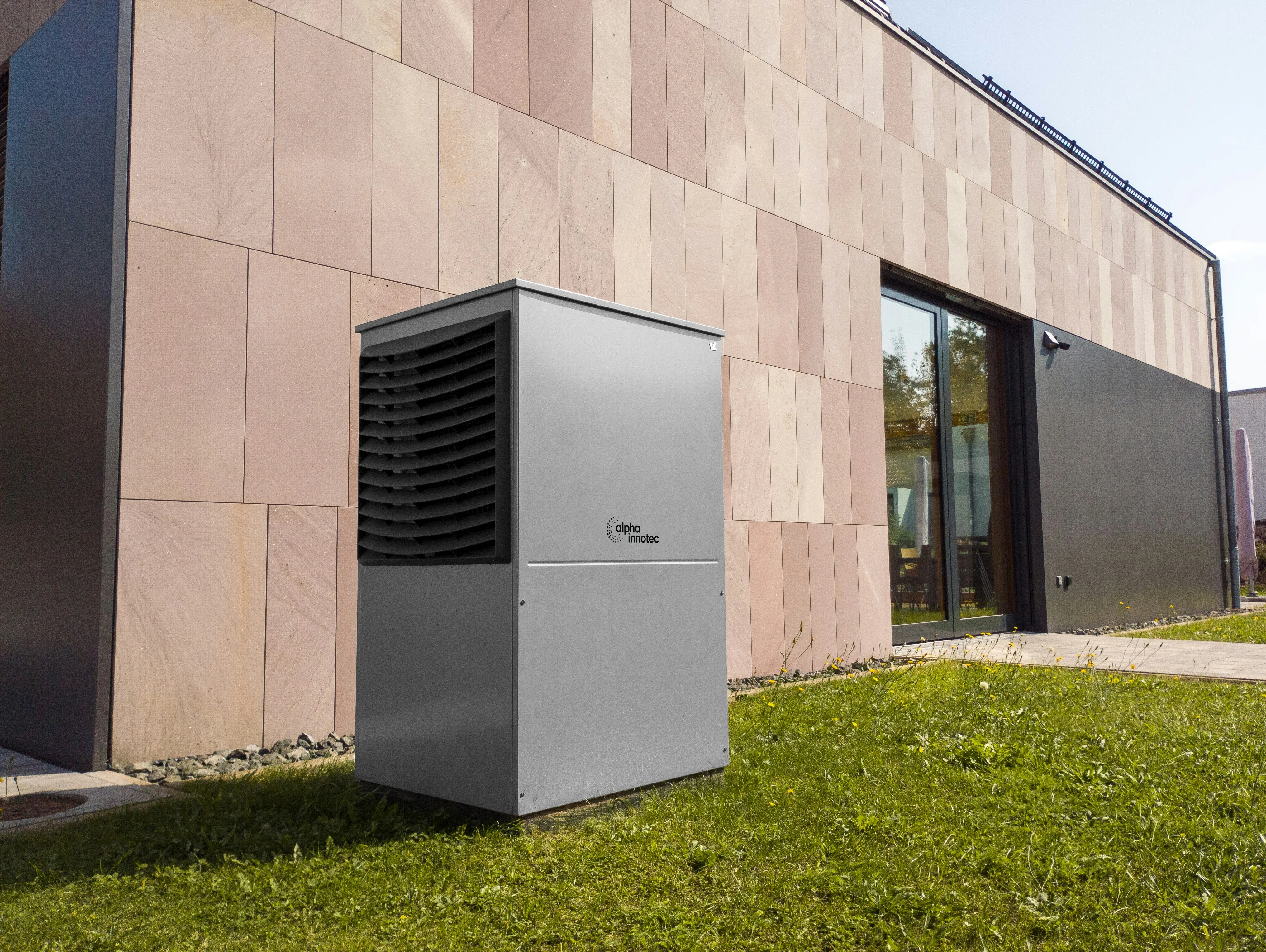
The outdoor unit (the box that sits outside containing the compressor, fan, and outdoor heat exchanger) must not exceed 1.5 cubic metres in volume. This is the post-December 2023 limit; the old limit was 0.6 m³. Most domestic heat pumps sold in the UK in 2026 — including typical 7–11 kW units that suit retrofit applications — fall well within the 1.5 m³ limit. A typical 8 kW unit is roughly 0.4–0.6 m³. Larger high-output systems (16 kW+) may approach the limit; this should be checked against the manufacturer datasheet at design stage.
2. Only one unit (or two for detached homes)
A maximum of one heat pump per dwelling is permitted under PD. The single exception, introduced by the 2023 amendment, is that detached dwellings can install up to two heat pumps under PD. Properties with two heat pumps must satisfy all other conditions on each unit, and the combined noise impact must comply with MCS 020(a) at the neighbour boundary.
3. Siting and placement restrictions
The outdoor unit must be on a building or within the curtilage of the home, must not be on a pitched roof, and must not be within 1 metre of the edge of a flat roof. The 1-metre rule for boundaries was removed in December 2023 — but it still applies to flat-roof edges. This catches some installers out; the two restrictions sound similar but apply to different things.
Other siting restrictions: the unit must be used solely for heating or cooling at the dwelling (not commercial use) and must be removed when no longer needed for that purpose.
4. Noise assessment passing MCS 020(a) at 37 dB
This is the load-bearing condition for most modern installs. The installation must comply with the MCS Planning Standards (MCS 020(a)) noise calculation at the nearest habitable room window of the nearest neighbouring property — and the calculated sound level must not exceed 37 dB LAeq,5min under the September 2025 update.
The calculation accounts for:
- The unit’s published sound power level (from the manufacturer datasheet)
- The distance from the unit to the neighbour’s nearest window
- Reflective surfaces (walls behind or beside the unit that bounce sound)
- Any acoustic barriers (fences, dedicated enclosures) with documented attenuation values
Your MCS-certified installer performs this calculation using the official MCS 020(a) calculator. The output is a signed declaration confirming the install falls under PD. It’s the homeowner’s evidence of PD compliance — keep it with the property records.
To give a directional sense of what passes and what doesn’t: a 7 kW Daikin Altherma 3 monobloc (sound power ~62 dB(A)) sited 4.5 m from a neighbour’s window with a 1.8 m fence between unit and boundary typically calculates to ~33–35 dB at the assessment point — comfortably within 37 dB. A larger 12 kW unit with a higher sound power level at the same siting may fail the test without additional acoustic treatment. Unit choice and siting matter; the noise calculation is the discipline test on both.
What changed in 2023 — the boundary rule and unit size
SI 2023/1279 came into force on 1 December 2023 and made three substantive changes to Class G:
-
The 1-metre boundary rule was removed. Previously, the outdoor unit had to sit at least 1 metre from the edge of the property curtilage. This rule was the single biggest obstacle to PD installs in terraced houses, dense semi-detached properties, and small inner-city plots. It’s gone. The unit can now sit anywhere on the property, subject to the noise condition.
-
The unit size limit jumped from 0.6 m³ to 1.5 m³. This effectively brings every domestic-grade ASHP within the limit. The old 0.6 m³ limit excluded some larger commercial units; the new 1.5 m³ limit excludes effectively nothing in the domestic market.
-
The PD scope was widened to cover heating-and-cooling systems. Previously, only heating-only units fell under Class G. Reversible systems (which can provide cooling in summer as well as heating) are now within PD. This matches the technology trend — most modern ASHPs are inverter-driven and can reverse the cycle for cooling without additional hardware.
The political driver behind these changes was simple: the UK has committed to roll out heat pumps at scale to support the net-zero pathway, and the 1-metre boundary rule was a known siting blocker. Removing it widened the practical install base significantly.
What changed in 2025 — the MCS 020(a) noise update
The Microgeneration Certification Scheme (MCS) published MCS 020(a) Issue 1.0 in March 2025, and it became mandatory for PD compliance on 20 September 2025.
Three substantive changes:
-
The noise limit dropped from 42 dB(A) at 1 m to 37 dB LAeq,5min at the assessment position. The reference point also changed — the assessment is now at the nearest habitable window of the nearest neighbour, with a 5-minute time-weighted measurement, rather than the previous flat-rate measurement.
-
Acoustic barrier guidance was formalised. Previously, the standard gave vague allowance for fences and walls to reduce calculated sound; MCS 020(a) now publishes specific attenuation values for different barrier types, allowing more precise design decisions.
-
From 28 May 2026, MCS 020 is the only permitted certification scheme under PD for England. Equivalent alternatives previously accepted are no longer.
The 5 dB tightening (42 → 37 dB) sounds small but matters in practice. A 5 dB reduction at the assessment point typically means roughly a 75% reduction in perceived loudness — and it places more emphasis on (a) choosing a quieter unit, (b) siting the unit to maximise distance to the neighbour window, and (c) using acoustic mitigation where the standard siting doesn’t pass.
For dense streetscapes — Victorian terraces, narrow semi-detached gaps, side-return installations — the new threshold means the installer’s MCS 020(a) calculation has to be performed carefully and the design has to be honest about what the chosen unit and siting deliver.
Five situations where PD does not apply
Class G PD is not available in five common situations:
1. Conservation areas — front-facing installs
In conservation areas, PD does not apply where the heat pump would be installed on a wall or roof fronting a highway — typically the front of the property facing the street, but also side elevations visible from the road. The rear of the property (where heat pumps are usually sited anyway) remains PD-eligible in conservation areas, provided the other conditions are met.
This is the most common conservation-area issue. In Reading, this affects properties in the St Peter’s, Caversham, central Reading, and east Reading conservation areas, among others. Rear-garden siting almost always remains PD-eligible; front-facing siting almost never is.
For a deep-dive on the conservation-area planning route, see our guide on heat pumps in Reading’s conservation areas.
2. Listed buildings
PD does not apply to any work affecting a listed building. The heat pump itself, the outdoor unit’s siting, and any pipework or external-wall penetration all require Listed Building Consent (LBC) — a separate consent regime under the Planning (Listed Buildings and Conservation Areas) Act 1990.
Listed-building installs are usually feasible, but they require pre-application consultation with the local council’s conservation officer, a heritage statement explaining the impact on the listed structure, and often discreet siting (rear courtyards, basement wells, or specialist screening). The timeline is longer — 8–13 weeks from application to decision is typical, rather than the 8 weeks for a straightforward PD-route install.
3. Flats and maisonettes
Class G applies only to dwellinghouses, not to flats or maisonettes. Installs on flats require a full planning application even where all the Class G conditions would otherwise be met.
Separately, flat owners also need freeholder consent under the terms of their lease. This is a contractual question, not a planning one, and it’s a frequent obstacle to heat pump installs in leasehold properties even where the planning side is approvable.
4. Article 4 directions
A local council can issue an Article 4 direction removing PD rights in a defined area. Article 4 is most often used to protect conservation areas, World Heritage Sites, and similar designated areas from cumulative incremental change. Where an Article 4 direction covers Class G, planning permission is required even if all other PD conditions would be satisfied.
You can check the Article 4 register via the Planning Portal or your local council’s planning policy pages. Your installer’s planning-check at the design stage should include this; if it doesn’t, ask.
5. National Parks, AONBs, and World Heritage Sites
PD is restricted in National Parks, Areas of Outstanding Natural Beauty (now called National Landscapes), the Broads, and World Heritage Sites. Reading-area properties are not typically affected — none of these designations cover Reading itself — but properties on the western fringes of West Berkshire (toward the North Wessex Downs National Landscape) may be subject to additional restrictions.
The full planning application route — process and timeline
Where PD doesn’t apply, a full planning application is required.
For Reading-area properties:
- Reading Borough Council covers central Reading, Caversham, Tilehurst (east), and Whitley
- West Berkshire Council covers Tilehurst (west), Thatcham, and Pangbourne
- Wokingham Borough Council covers Earley, Lower Earley, Woodley, and Twyford
The standard process:
| Stage | Typical duration |
|---|---|
| Pre-application discussion (recommended for conservation / listed) | 2–4 weeks |
| Application preparation | 1–3 weeks |
| Council validation of the application | 1–2 weeks |
| Public consultation + statutory consultees | 4–6 weeks |
| Officer decision (delegated cases) | 6–8 weeks from validation |
| Planning Committee (where called in) | 8–13 weeks from validation |
Fees (2026): A standard householder application costs £258. Listed Building Consent is free of charge. Pre-application advice fees vary between councils — Reading Borough Council charges approximately £101 for written householder pre-app advice as of May 2026.
Common reasons for refusal on conservation-area heat pump applications:
- Adverse noise impact on neighbours, even where MCS 020(a) marginally passes
- Visual impact on the character of a conservation area, especially on front elevations
- Harm to the setting of a listed building (group setting, not just the listed property itself)
- Streetscape cumulative impact in densely-listed terraces
Rear-sited applications with adequate acoustic treatment typically receive consent; front-facing applications in sensitive areas often don’t. Your installer’s design should account for this at the survey stage, not at the application stage.
What your installer should produce as PD evidence
For a PD-route install, your MCS-certified installer should give you:
- The MCS 020(a) sound calculation showing the calculated dB level at the nearest neighbour’s habitable window — this should be at or below 37 dB
- A signed Class G compliance declaration confirming all four PD conditions are satisfied
- The MCS installation certificate (also required for the BUS grant — see our BUS grant guide)
- The manufacturer datasheet showing the unit’s dimensions (≤ 1.5 m³) and sound power level
These documents are not filed with the council. They’re retained by you as proof of PD compliance — and they form part of the property records that pass to future buyers. If a neighbour complains to the council post-install, this is the evidence pack that demonstrates compliance.
Optional: Lawful Development Certificate (LDC). Some homeowners apply for a Certificate of Lawfulness of Proposed Use or Development before installation — a formal council confirmation that PD applies. The fee is £129 (half the standard application fee). This isn’t legally required, but is sometimes used by homeowners selling within 12 months of install, by mortgage lenders requiring certainty, or where the conservation area boundary is ambiguous. It’s a useful belt-and-braces option for the cautious.
If the noise calculation doesn’t pass — four options
Where the MCS 020(a) calculation marginally exceeds 37 dB at the neighbour boundary, four design changes can usually bring it within range:
-
Re-site the unit further from the boundary window. Each doubling of distance reduces calculated sound by approximately 6 dB. Moving from 3 m to 6 m from the neighbour window typically brings a marginal fail comfortably within range.
-
Install an acoustic barrier. A sound-attenuating fence, wall, or dedicated enclosure with MCS-documented attenuation can knock 5–10 dB off the calculated level. MCS 020(a) publishes specific attenuation values for different barrier types.
-
Choose a quieter unit. Manufacturers publish sound power levels per model. Modern inverter-controlled monobloc units running on R290 propane tend to be quieter than older R32 units at equivalent capacity. The 1–2 dB difference between models can make the calculation pass.
-
Install a dedicated acoustic enclosure. Proprietary heat pump enclosures with engineered attenuation typically reduce sound by 5–10 dB. Important caveat: the enclosure must not impede airflow per the manufacturer’s ventilation specification, or the unit’s performance degrades and warranty may be affected.
If none of these bring the calculation below 37 dB, the install does not qualify for PD. A full planning application is still possible — the MCS 020(a) threshold is the PD test, not the absolute planning test — and the local council may still grant consent based on its own noise assessment.
What this means for homes in Reading
Reading’s housing stock distributes broadly across four eras: Victorian and Edwardian terraces in central Reading and parts of lower Caversham; 1930s and inter-war semi-detached homes in Tilehurst, Earley, and Whitley; 1960s–80s estates in Lower Earley, Woodley, and parts of Tilehurst; and modern post-2000 estates on western expansion sites.
For each property type, the planning route typically resolves as follows:
-
Victorian and Edwardian terraces (central Reading, lower Caversham, east Reading): PD route in most cases for rear-garden siting, with careful MCS 020(a) treatment because of the close boundaries with adjoining properties. The 2023 abolition of the 1-metre rule has made these properties significantly more PD-feasible than before. Conservation area status (St Peter’s, central Reading conservation areas) restricts PD for front-facing installs — rear siting almost always remains available.
-
1930s and inter-war semi-detached (Tilehurst, Earley, Whitley): Almost always PD-route. Larger plot sizes mean the noise calculation passes comfortably and conservation-area restrictions rarely apply. The rear-garden access is typically straightforward.
-
1960s–80s estates (Lower Earley, Woodley, parts of Tilehurst): Universally PD-route. These properties were built to higher modern noise specifications, plot sizes are generous, and conservation areas don’t apply. Often the simplest planning case in Reading.
-
Modern post-2000 estates (western expansion): PD-route, with the additional consideration that some newer estates have estate-management covenants restricting external alterations. These are private contractual restrictions enforced by the estate management company, separate from planning law. Check covenants alongside the PD check.
For listed buildings in Reading — concentrated in central Reading, parts of Caversham, and individual listed properties scattered elsewhere — Listed Building Consent is required in addition to any planning application. The Reading Borough Council conservation officer is the relevant point of contact, and pre-application consultation is strongly recommended.
For flats and leasehold properties in central Reading and the redevelopment quarters — increasingly common around Reading station, the Kennetside, and the Christchurch Bridge area — both planning permission and freeholder consent are typically needed. The freeholder-consent question is often the harder one; many leases prohibit external alterations without explicit consent, and the response varies widely between freeholders.
Reading Borough Council’s online planning portal is the route to check existing planning constraints on a specific address before commissioning an install. Your installer should perform this check at the design stage as part of the standard survey.
Three questions to ask before committing to an install
When you receive a quote, three questions establish whether the planning side is handled properly:
-
“Have you performed the MCS 020(a) sound calculation for this property, and what level does it return at the nearest neighbour window?” The answer should be a specific number in dB LAeq,5min, with the assessment position identified. If the installer can’t produce this, they haven’t done the standard PD compliance check.
-
“Is my property in a conservation area or covered by an Article 4 direction, and have you checked the listing register?” The installer’s design should include a planning-feasibility check covering all five PD exclusions. If the answer is “we’ll find out closer to install,” that’s a flag.
-
“Are you providing the Class G compliance declaration and MCS 020(a) calculation document for my records?” These should be supplied as standard at handover. They’re your evidence of PD compliance and should pass to future buyers with the property records.
A well-run install handles the planning side at the survey stage, not the install stage. By the time you commit to the quote, the planning route should be settled and the evidence pack should be specified as a deliverable.
Related guides
- Heat pumps in Reading’s conservation areas — the conservation-area + listed-building deep-dive
- What is MCS certification? A buyer’s guide — the MCS installer-credential framework behind the PD declaration
- Where to site your outdoor heat pump unit — the practical siting deep-dive that complements PD compliance
- Finding an MCS-certified installer in Reading — the local-installer matching that ensures PD documentation is supplied
Get a quote — survey your property for heat pump suitability, including the planning feasibility check, by an MCS-certified installer in Reading.
Call us on 0118 [number] | Email [address]
See what a heat pump would look like in your Reading home
The mechanism is the same in every UK home; the design is specific to yours. Our team carries out a free in-home survey including a full room-by-room heat-loss calculation, identifies the system size and configuration that fits your property, and provides a written quote with the £7,500 BUS grant already deducted.
You'll see the actual figure you'd pay — not an estimate — and the projected efficiency for your specific install.