What is an air source heat pump? A complete UK homeowner's guide
Last reviewed: 14 May 2026
An end-to-end orientation for UK homeowners: what an air source heat pump is, how it compares to a gas boiler, what your property needs, and what the BUS-grant-and-policy landscape looks like in 2026.
Last reviewed: 14 May 2026
In short
An air source heat pump is an electrically-powered heating system that moves heat from the outdoor air to your home’s wet central heating system and hot water cylinder — rather than burning fuel to make heat. Because it’s transferring heat that’s already there, a typical UK installation delivers around 3.0–4.0 units of heat per 1 unit of electricity consumed (the Seasonal Coefficient of Performance, or SCOP). A modern gas boiler, by comparison, delivers around 0.85–0.92 units of heat per 1 unit of gas. Air-to-water heat pumps — the type that connects to your existing radiators and a hot water cylinder — are eligible for a £7,500 Boiler Upgrade Scheme grant in 2026, installed under the MCS-administered design and install standards (MIS 3005-D V3.0 + MIS 3005-I, mandatory from 5 December 2025). They are the default low-carbon retrofit heating option in the UK, with around 51,000+ installs in 2024 and growing each year.
Contents
- The core mechanic — moving heat, not making it
- What an air source heat pump includes
- What an ASHP doesn’t include and what it doesn’t do
- How a heat pump compares to alternatives
- Where ASHPs fit in the UK heat transition
- What your property needs
- The typical UK install in 2026
- The decision shape for a homeowner
- What this means for homes in Reading
The core mechanic — moving heat, not making it
A heat pump is, mechanically, a refrigerator running in reverse. Both use the same four-component refrigerant cycle (compressor, condenser, expansion valve, evaporator), and both use a working fluid — the refrigerant — that absorbs heat at one location and releases it at another.
A fridge absorbs heat from the food inside and releases it to the air at the back of the appliance. A heat pump absorbs heat from the outdoor air and releases it to the indoor wet heating system. The physics are identical; the orientation is opposite.
The reason heat pumps deliver more energy than they consume is they’re transferring heat that’s already present in the outdoor air — not generating new heat. Even at 0°C, ambient air contains substantial thermal energy. The compressor uses electrical work to concentrate that ambient heat into a useful form, and the ratio of useful heat output to electrical work input is the coefficient of performance (COP). The seasonal average across a typical UK heating year is the SCOP.
This is the property that makes heat pumps economically viable. A 1 kW input of electricity moving 3 kW of heat into a building is cheaper per kWh of heat than a 1 kW input of gas producing 0.9 kW of heat — provided the unit-rate ratio between electricity and gas falls below the SCOP-to-boiler-efficiency ratio. In the UK in 2026, that condition is met for most properties on most tariffs, sometimes narrowly, sometimes substantially. Our running cost guide walks through the arithmetic in depth.
What an air source heat pump includes
A typical UK air-to-water heat pump installation comprises:
-
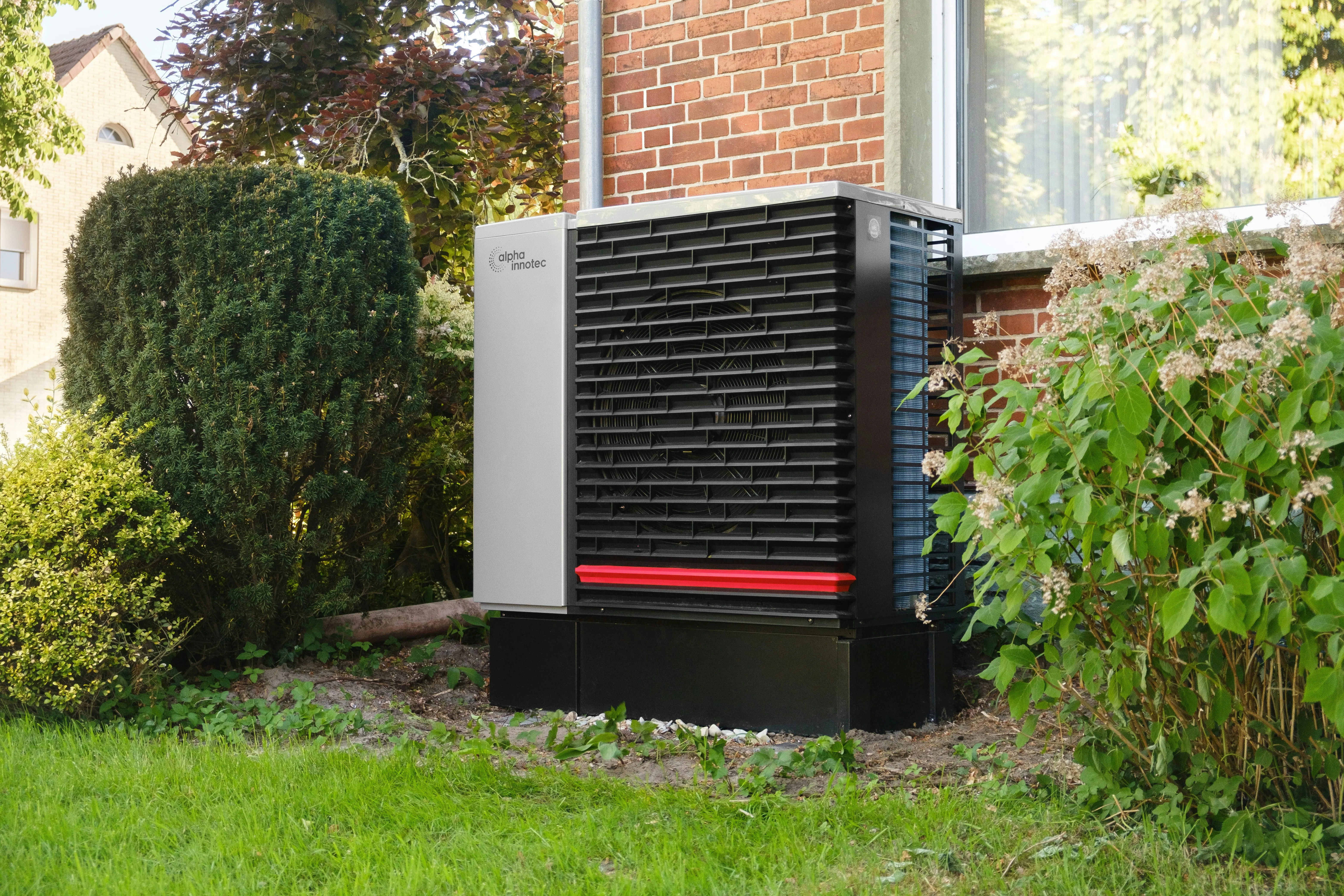
Outdoor unit — the heat pump itself. Wall-mounted or ground-standing on a paving slab, typically at the side or rear of the house. Roughly the size of a small chest freezer (a 7 kW unit is typically ~90 cm × 70 cm × 80 cm). Houses the compressor, outdoor heat exchanger, fan, and inverter electronics.
-
Hot water cylinder — typically 180–250 L unvented, located in an internal cupboard, utility, or loft. The heat pump heats stored hot water in the cylinder via a built-in coil heat exchanger; the cylinder supplies your taps and showers. A heat pump install is the point at which a combi-boiler household typically transitions to a cylinder-and-tank arrangement.
-
Hydraulic separator or buffer tank (sometimes) — a small additional water tank specified per MIS 3005-D V3.0 design rules when the radiator circuit’s volume is below the heat pump’s minimum requirement.
-
Existing or upgraded radiators — the heat pump delivers heat at a lower flow temperature than a gas boiler (typically 45–55°C vs the boiler’s 70°C+), which means radiators need to be larger to deliver the same room heat output. Some existing radiators are still large enough; others need upgrading.
-
Controls — typically a weather-compensation-capable controller that adjusts flow temperature based on outdoor temperature, often paired with a smart thermostat for room-level control.
-
Electrical connection — a dedicated MCB on your consumer unit, sometimes a 100A single-phase supply upgrade, and a DNO notification submitted to your Distribution Network Operator.
The install typically takes 1–5 days on site, depending on whether existing pipework and radiators need replacement. The pre-install survey and design phase typically takes 2–4 weeks.
What an ASHP doesn’t include and what it doesn’t do
Three common misconceptions worth naming explicitly:
It is not a combi heat pump. No commercially-available heat pump in the UK provides instant hot water without a cylinder. The combi-boiler arrangement — hot water heated on demand at the tap — is incompatible with a heat pump’s lower output temperature and slower response. A heat pump install requires a hot water cylinder.
It is not a “fit and forget” plug-in upgrade. Unlike replacing a gas boiler with a new gas boiler — which can typically be done in 1–2 days using existing radiators, pipework, and gas supply — replacing a gas boiler with a heat pump requires a heat-loss survey, often radiator upgrades, sometimes pipework upgrades, electrical supply checks, hot water cylinder installation, and DNO notification. The work scope is larger and the design phase matters more.
It is not the same technology as air conditioning (in the UK retrofit context). Air conditioning units — including reversible “air-to-air” heat pumps that deliver warm or cool air through internal air units — are a different product class from the air-to-water heat pumps that dominate UK retrofit. Air-to-air systems are eligible for a separate £2,500 BUS grant since April 2026, but they connect to internal air units rather than your wet central heating system or hot water cylinder. They are not interchangeable.
How a heat pump compares to alternatives
Five technologies cover most UK domestic heating in 2026:
| Technology | Heat source | Approximate efficiency | Carbon intensity (per kWh heat) | Retrofit suitability |
|---|---|---|---|---|
| Air source heat pump | Outdoor air → wet heating system | SCOP 3.0–4.0 (≈ 300–400% “effective”) | Falls with grid decarbonisation; 2026 ≈ 60 g CO₂/kWh | Default low-carbon retrofit option |
| Gas boiler | Natural gas (mains) | 85–92% (modern condensing) | ≈ 200 g CO₂/kWh | Currently dominant; install ban for new build from 2025 |
| Oil boiler | Heating oil (off-grid) | 85–90% | ≈ 260 g CO₂/kWh | Off-grid only; £9,000 BUS uplift expected July 2026 |
| Direct electric | Storage / panel / immersion | ~100% (point-of-use; no transfer) | ≈ 200 g CO₂/kWh (2026 grid) | High running cost; flats or small properties only |
| Ground source heat pump | Ground loop / borehole → wet heating system | SCOP 3.5–4.5 | Falls with grid decarbonisation | Higher install cost (£18,000–£35,000); suited to large rural plots |
The headline comparison: heat pumps deliver 3–4× more heat per kWh of input energy than gas, oil, or direct-electric boilers. The cost arithmetic depends on the unit-rate ratio between electricity and gas/oil — favourable enough in 2026 that a properly-sized heat pump on a heat-pump-specific tariff typically runs at or below gas-equivalent cost. Our 15-year cost comparison and running cost guide cover the economics in depth.
The carbon comparison: at the 2026 grid intensity, a heat pump produces roughly 30% the CO₂ per kWh of heat that a gas boiler produces. The advantage grows as the UK electricity grid decarbonises — National Grid ESO projects grid intensity falling to ~30 g CO₂/kWh by 2035 under the current decarbonisation pathway.
Where ASHPs fit in the UK heat transition
The UK has committed to net zero greenhouse gas emissions by 2050. Domestic heating accounts for roughly 14% of UK greenhouse gas emissions, with gas boilers as the dominant heat source. Three structural commitments are reshaping the market:
-
The Future Homes Standard 2025 prohibits the installation of gas boilers in new-build homes (with limited transitional exemptions). New-build homes from 2025 are typically heated via air-to-water heat pumps with low-flow-temperature radiator or underfloor systems.
-
The Boiler Upgrade Scheme (BUS) provides a £7,500 grant toward an air-to-water heat pump installation, currently funded to 31 March 2030 (extended from the original 2028 sunset by SI 2026/390, April 2026). Our BUS grant guide covers eligibility and application in depth. From July 2026, off-gas oil/LPG homes are expected to receive a £9,000 uplift on the grant, increasing the total to ~£12,000–£13,500 depending on the homeowner’s previous heat source.
-
The Clean Heat Market Mechanism (introduced 2024, refined 2025) places gradually-rising targets on boiler manufacturers to sell more heat pumps as a proportion of their total annual UK sales — bringing heat pump production scale up and unit costs down toward gas boiler parity.
The result: in 2026 the UK retrofit heating market is in transition. Gas boilers are still the dominant install for existing homes, but heat pumps are the only domestic heating system actively subsidised, the only one consistent with the long-term policy trajectory, and increasingly the natural choice for property owners thinking about a 15-year asset replacement.
What your property needs
Five practical conditions affect whether a heat pump fits your home without significant additional work:
1. Space for the outdoor unit. A typical 7–11 kW unit needs ~1 m² of floor or wall space with clearance for airflow (typically 30 cm behind, 50 cm in front, 30 cm at the sides). The unit’s noise envelope must comply with MCS 020 — typically ≤ 42 dB at 1 m from the nearest habitable window of the nearest neighbouring property.
2. Space for the hot water cylinder. A 180–250 L unvented cylinder needs an internal cupboard, utility, or loft space. Loft installation typically requires structural loading checks and frost protection of the pipework.
3. Adequate electrical supply. Most UK homes have a single-phase 100 A supply, which is sufficient for typical residential heat pumps. Older properties with a 60 A supply may need a DNO upgrade. Three-phase supplies are required for larger units (typically 16 kW+) or for properties with cascaded installs.
4. Radiator capacity at low flow temperature. Existing radiators were typically sized for a gas boiler flow temperature of 70°C+. At the heat pump’s design flow temperature of 45–55°C, radiator output drops to ~50–65% of its rated output. Some radiators are still adequate; others need upgrading or replacing. The heat-loss survey identifies which.
5. Reasonable fabric performance. A heat pump can heat any home, but properties with very high heat loss (poor insulation, single glazing, leaky envelope) need correspondingly larger heat pumps and lower SCOP. The “fabric first” principle — addressing insulation before installing the heat pump — produces better lifetime economics in most cases.
None of these is necessarily disqualifying. They are the design considerations a competent survey identifies and the install design accommodates. The function of the survey is to map your property’s conditions to the specific install design.
The typical UK install in 2026
A snapshot of the typical 2026 UK air-to-water heat pump install, drawing on Nesta / Ofgem BUS administration data:
- Median install size: ~8 kW (modal 7 kW)
- Typical install cost: median £13,041 gross, pre-grant
- Net cost after BUS grant: median ~£5,500–£6,000 for an air-to-water install eligible for the £7,500 grant
- Install duration on site: typically 1–5 days
- Design + survey + quote phase: typically 2–4 weeks
- Typical SCOP: 3.0–4.0 across current installs
- MCS-certified installer base: ~5,500 active MCS-certified contractors in the UK as of early 2026
- Year-on-year install volume: 51,000+ installs in 2024 (UK total, all heat pump types), growing each year
The market is functional and growing; the policy structure is supportive; the technical discipline — MIS 3005-D V3.0 + BS EN 12831-1:2017 — is the strongest it has been since the BUS grant launched in 2022.
The decision shape for a homeowner
For a UK homeowner considering a heat pump in 2026, the decision typically resolves to four questions:
-
Does my property work for a heat pump? The heat-loss survey is structured to answer this.
-
What will it cost, and what does the BUS grant cover? Install cost depends on property size, fabric, radiator upgrades, and electrical work — our cost guide and hidden costs cover this in depth. The BUS grant covers £7,500 of an air-to-water install.
-
What will it cost to run, and how does that compare to my gas bill? Running cost depends on SCOP, tariff (heat-pump-specific tariffs typically improve economics), and fabric. The running cost guide and 15-year comparison cover the economics.
-
What’s the right installer? MCS-certified installers are required for BUS grant eligibility; certification ensures the install is on the documented design standards.
The order matters. Survey first establishes whether a heat pump fits; cost arithmetic resolves whether the economics work for your household; installer choice resolves who carries out the install. Trying to compress this into a single quote-and-install decision typically produces design errors and reputational outcomes both buyer and installer want to avoid.
What this means for homes in Reading
Reading sits in the Thames Valley CIBSE weather region, with a design external temperature of −3.0°C (99.6% percentile, Heathrow reference) applied uniformly across the area. The local housing stock spans the full UK retrofit range:
-
Central Reading and lower Caversham carry Victorian and Edwardian terrace stock with solid 9” brick walls. Heat pumps work well in these properties, but the design typically needs 9–14 kW capacity and benefits substantially from internal wall insulation upgrades.
-
Tilehurst, Earley, Whitley, eastern Reading are inter-war and post-war semis with cavity walls. Where the cavity has been filled (most properties since the 1990s), heat pumps typically size at 6–9 kW with limited radiator-upgrade scope.
-
Lower Earley, Woodley, western and southern modern estates are 1980s+ insulated cavity construction. Heat pumps in these properties size at 5–8 kW and often work with existing radiators without significant upgrades.
-
Caversham Heights, Caversham Park, and central conservation areas contain period properties where fabric upgrades face planning constraints. Heat pumps here typically need the higher end of the property’s sizing range with a slightly higher design flow temperature.
Reading is on the gas grid, which means most retrofit installs are gas-boiler replacements eligible for the £7,500 BUS grant. Properties in the Reading borough are inside the Permitted Development boundary for noise (per MCS 020) and have access to standard Distribution Network Operator (SSEN) processes for electrical supply checks. The income profile in Reading is above the UK average — relevant for households for whom the heat pump’s upfront cost net of grant is the deciding factor.
For most Reading homeowners considering a heat pump in 2026, the next step is a heat-loss survey that produces the calculated load figure and the design flow temperature. From that, the cost arithmetic and the install design follow.
Related guides
- How does an air source heat pump work? — the technical deep-dive on the refrigerant cycle this article introduces in summary
- Air source vs ground source heat pumps — the technology comparison this article tables in summary (A3.1, publishes cadence)
- How much does a heat pump cost? — full UK install cost breakdown for 2026
- The BUS grant — complete guide — eligibility, application, and what’s covered
Get a quote for an MCS-compliant heat pump install in Reading. Our team handles the heat-loss survey, system design, install, and BUS grant administration. | Call us on 0118 [number] | Email [address]
See what a heat pump would look like in your Reading home
The mechanism is the same in every UK home; the design is specific to yours. Our team carries out a free in-home survey including a full room-by-room heat-loss calculation, identifies the system size and configuration that fits your property, and provides a written quote with the £7,500 BUS grant already deducted.
You'll see the actual figure you'd pay — not an estimate — and the projected efficiency for your specific install.